All Yono Bonus 51
UPI Limits 2026: The Strategic Blueprint for High-Volume Business Growth
Cracking the New UPI Codes: How to Move Up to ₹5 Lakh Daily Without Account Freezes
Digital payments in India have hit an astronomical scale, with the National Payments Corporation of India (NPCI) recording over 24,161 crore transactions valued at a staggering ₹314.23 lakh crore in the recently concluded fiscal year.
As the ecosystem matures, the governing bodies have shifted focus from simple transaction execution to system resilience, fraud reduction, and strict operational capping. If you are a high-volume merchant, independent contractor, or business owner handling frequent vendor payments, these updated 2026 guidelines dictate exactly how much capital you can move digitally each day without hitting a technical wall or getting hit with tax compliance notices.
Here is your comprehensive strategic blueprint to navigating the new UPI limit updates for 2026.
1. The Multi-Tiered Transaction Limits Matrix
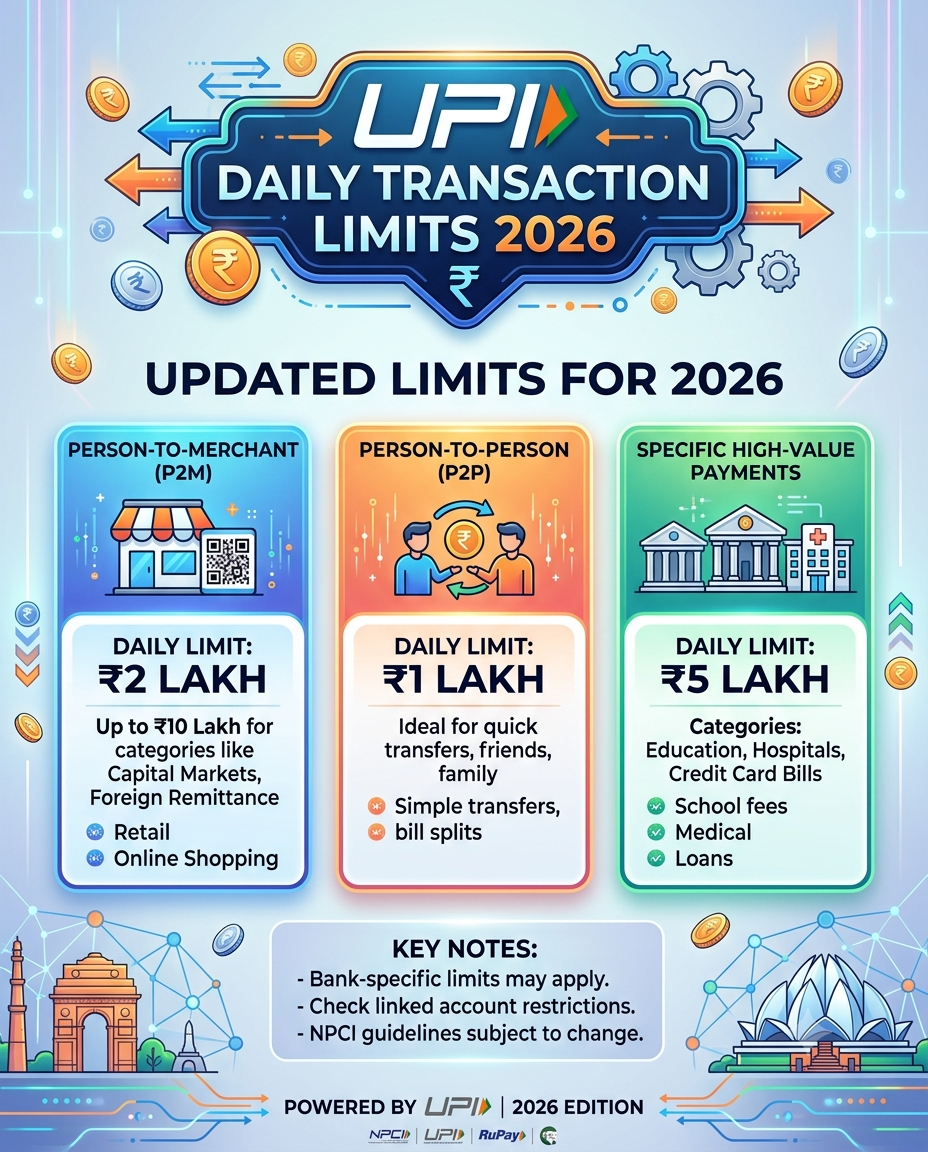
The overarching default rule set by the NPCI remains unchanged: a standard Person-to-Person (P2P) or basic Person-to-Merchant (P2M) transfer is capped at ₹1 lakh per day across all linked applications combined.
However, to accommodate larger corporate and essential payments, the framework actively enforces expanded transaction corridors up to ₹5 lakh for verified high-value categories.
Understanding Bank-Specific Variations
While the NPCI defines the upper ceiling, your specific commercial bank controls the local gate. Major tier-1 banks align cleanly with the standards, but regional or smaller cooperative institutions maintain tighter internal security thresholds:
State Bank of India (SBI), HDFC Bank, ICICI Bank, Axis Bank: Max out at the standard ₹1,00,000 daily ceiling.
Union Bank of India: Grants a flexible daily aggregate up to ₹2,00,000 for certain accounts.
Punjab National Bank (PNB): Restricts standard profiles to a conservative ₹50,000 per day.
Regional Rural & Co-operative Banks: Frequently scale thresholds down between ₹25,000 to ₹50,000 to manage liquidity and server loads.
2. Hidden Bottlenecks That Freeze Your Account
Many business operators experience payment failure long before touching their monetary cap. The new 2026 infrastructure heavily prioritizes system performance and anti-fraud protocols, giving rise to secondary limitations:
The 20-Transaction Count Wall: Regardless of the remaining rupee balance on your account, the system limits users to 20 outgoing UPI transactions within a rolling 24-hour window. If you run 20 micro-payments of ₹500 to clear staff expenses, your primary UPI layer locks down instantly for the rest of the cycle. Note that this 24-hour reset window starts counting from the time of your first transfer, not at midnight.
The New User/Device Freeze: If you register a new UPI account or change the hardware device housing your current SIM card, a strict safety filter throttles your account to a maximum of ₹5,000 total for the initial 24 hours.
The API Scrape Cap: To protect core banking interfaces from heavy data loops, users are restricted to a maximum of 50 balance checks per day per app. Over-querying your balance can flag the app for temporary access suspension.
3. Advanced Tactical Countermeasures for Business Owners
If your company generates heavy transaction frequency, staying dependent on a single retail banking app framework will inevitably stall operations. Implement these structural adjustments to decouple your operational cash flow:
Route Micro-Expenses via UPI Lite
For day-to-day operational transactions, switch entirely to UPI Lite. Following the updated NPCI circular adjustments, the single-transaction cap for UPI Lite stands at ₹1,000, with an on-device digital wallet maximum balance of ₹5,000.
The Ultimate Loophole: Outgoing transactions executed from your pre-funded UPI Lite wallet do not count toward your core bank account's 20-transaction frequency limit or your daily ₹1 lakh monetary cap. Use it for fuel, tea, and quick runner tasks to keep your main banking lines clear for high-value supplier invoices.
Audit Pre-Transaction Verification Screens
To mitigate the ongoing issue of misdirected payments, the NPCI mandates that all major payment aggregators (Google Pay, PhonePe, Paytm) match account data directly to the official Validate Address API. Ensure your vendors have updated their merchant legal titles; the pre-transaction confirmation layout will now display the exact banking name rather than customizable aliases, allowing you to bypass manual test-rupee transfers.
Mind the Compliance Layer
While traditional peer-to-peer (P2P) transfers remain entirely free of charge, transactions crossing over the ₹2,000 threshold that originate from Prepaid Payment Instruments (PPIs) like digital corporate wallets can attract merchant interchange structures ranging between 0.5% to 1.1% depending on the specific sector.
Furthermore, high-volume digital cash inflows are closely tracked under Specified Financial Transactions (SFT) data loops. Consistently pulling hundreds of peer transfers into personal savings accounts without proper bookkeeping can trigger automated Income Tax notices or invite unexpected scrutiny regarding GST registration thresholds (₹40 lakh for goods / ₹20 lakh for services).
The Bottom Line
If your weekly operations cross into multiple lakhs, relying heavily on personal savings accounts linked to retail UPI handles is an operational hazard. Migrate your core flows to a dedicated Corporate Current Account mapped with the correct Merchant Category Code (MCC) to lift security freezes and keep your business moving smoothly in 2026.
Digital payments in India have hit an astronomical scale, with the National Payments Corporation of India (NPCI) recording over 24,161 crore transactions valued at a staggering ₹314.23 lakh crore in the recently concluded fiscal year.
As the ecosystem matures, the governing bodies have shifted focus from simple transaction execution to system resilience, fraud reduction, and strict operational capping. If you are a high-volume merchant, independent contractor, or business owner handling frequent vendor payments, these updated 2026 guidelines dictate exactly how much capital you can move digitally each day without hitting a technical wall or getting hit with tax compliance notices.
Here is your comprehensive strategic blueprint to navigating the new UPI limit updates for 2026.
1. The Multi-Tiered Transaction Limits Matrix
The overarching default rule set by the NPCI remains unchanged: a standard Person-to-Person (P2P) or basic Person-to-Merchant (P2M) transfer is capped at ₹1 lakh per day across all linked applications combined.
However, to accommodate larger corporate and essential payments, the framework actively enforces expanded transaction corridors up to ₹5 lakh for verified high-value categories.
Understanding Bank-Specific Variations
While the NPCI defines the upper ceiling, your specific commercial bank controls the local gate. Major tier-1 banks align cleanly with the standards, but regional or smaller cooperative institutions maintain tighter internal security thresholds:
State Bank of India (SBI), HDFC Bank, ICICI Bank, Axis Bank: Max out at the standard ₹1,00,000 daily ceiling.
Union Bank of India: Grants a flexible daily aggregate up to ₹2,00,000 for certain accounts.
Punjab National Bank (PNB): Restricts standard profiles to a conservative ₹50,000 per day.
Regional Rural & Co-operative Banks: Frequently scale thresholds down between ₹25,000 to ₹50,000 to manage liquidity and server loads.
2. Hidden Bottlenecks That Freeze Your Account
Many business operators experience payment failure long before touching their monetary cap. The new 2026 infrastructure heavily prioritizes system performance and anti-fraud protocols, giving rise to secondary limitations:
The 20-Transaction Count Wall: Regardless of the remaining rupee balance on your account, the system limits users to 20 outgoing UPI transactions within a rolling 24-hour window. If you run 20 micro-payments of ₹500 to clear staff expenses, your primary UPI layer locks down instantly for the rest of the cycle. Note that this 24-hour reset window starts counting from the time of your first transfer, not at midnight.
The New User/Device Freeze: If you register a new UPI account or change the hardware device housing your current SIM card, a strict safety filter throttles your account to a maximum of ₹5,000 total for the initial 24 hours.
The API Scrape Cap: To protect core banking interfaces from heavy data loops, users are restricted to a maximum of 50 balance checks per day per app. Over-querying your balance can flag the app for temporary access suspension.
3. Advanced Tactical Countermeasures for Business Owners
If your company generates heavy transaction frequency, staying dependent on a single retail banking app framework will inevitably stall operations. Implement these structural adjustments to decouple your operational cash flow:
Route Micro-Expenses via UPI Lite
For day-to-day operational transactions, switch entirely to UPI Lite. Following the updated NPCI circular adjustments, the single-transaction cap for UPI Lite stands at ₹1,000, with an on-device digital wallet maximum balance of ₹5,000.
The Ultimate Loophole: Outgoing transactions executed from your pre-funded UPI Lite wallet do not count toward your core bank account's 20-transaction frequency limit or your daily ₹1 lakh monetary cap. Use it for fuel, tea, and quick runner tasks to keep your main banking lines clear for high-value supplier invoices.
Audit Pre-Transaction Verification Screens
To mitigate the ongoing issue of misdirected payments, the NPCI mandates that all major payment aggregators (Google Pay, PhonePe, Paytm) match account data directly to the official Validate Address API. Ensure your vendors have updated their merchant legal titles; the pre-transaction confirmation layout will now display the exact banking name rather than customizable aliases, allowing you to bypass manual test-rupee transfers.
Mind the Compliance Layer
While traditional peer-to-peer (P2P) transfers remain entirely free of charge, transactions crossing over the ₹2,000 threshold that originate from Prepaid Payment Instruments (PPIs) like digital corporate wallets can attract merchant interchange structures ranging between 0.5% to 1.1% depending on the specific sector.
Furthermore, high-volume digital cash inflows are closely tracked under Specified Financial Transactions (SFT) data loops. Consistently pulling hundreds of peer transfers into personal savings accounts without proper bookkeeping can trigger automated Income Tax notices or invite unexpected scrutiny regarding GST registration thresholds (₹40 lakh for goods / ₹20 lakh for services).
The Bottom Line
If your weekly operations cross into multiple lakhs, relying heavily on personal savings accounts linked to retail UPI handles is an operational hazard. Migrate your core flows to a dedicated Corporate Current Account mapped with the correct Merchant Category Code (MCC) to lift security freezes and keep your business moving smoothly in 2026.